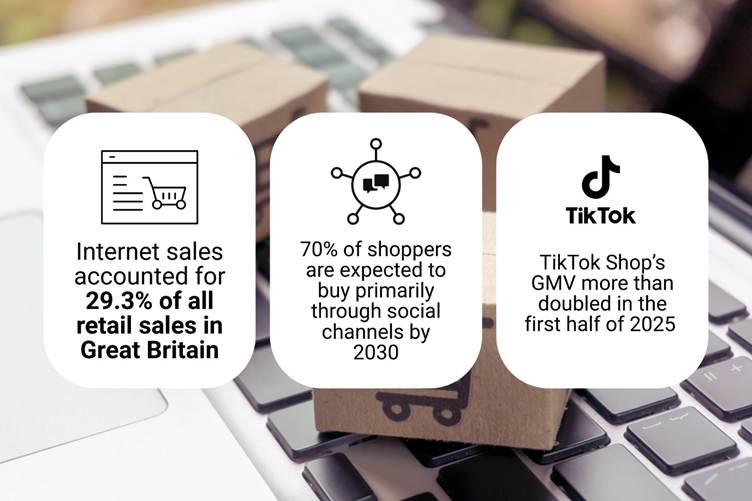
Ecommerce and Efulfillment continues to rapidly accelerate, fuelled by shifting shopping habits, the rise of social commerce, and higher consumer expectations than ever before. Today, consumers are chronically online. Platforms like TikTok, Instagram, and YouTube now act as powerful discovery hubs, keeping consumers constantly connected to a stream of products and enabling seamless, in the moment purchases. In December 2025, internet sales accounted for 29.3% of all retail sales in Great Britain, a figure that underlines just how embedded online shopping has become in everyday life. Today’s consumers expect every interaction to be fast, intuitive, and tailored to them, with little tolerance for friction or delay. This shift is driving brands to rethink not only how they sell, but how they fulfil, accelerating the adoption of AI-driven personalisation, mobile-first commerce, and smarter, more responsive fulfilment models. To understand what this means for brands and fulfilment operations, we spoke with Joe Peers, Head of Ecommerce at Dee Set, about how the e‑fulfilment landscape is evolving, why traditional warehouses struggle, and how brands can scale confidently in 2026. Q1. E-commerce keeps growing every year, but what’s really driving that change now? Joe Peers: If you look at how people shop today compared to even a few years ago, the shift is huge. What used to be fairly straightforward, main marketplaces, retailer websites, and the occasional D2C brand, has exploded into a whole ecosystem of places where customers discover and buy products. A big driver of that growth is simply that consumers are spending more of their day inside social platforms. One study noted that around 70% of shoppers expect to buy primarily through social channels by 2030 (DHL E-Commerce Trends, 2025). This says a lot about how habits have changed. People no longer see shopping as a separate activity. It blends into the same space where they watch videos, talk to friends, and share content. And because of this, buying has become more spontaneous and far more integrated into daily life. Another factor is how easy and enjoyable online shopping has become. Social commerce, in particular, has removed lots of friction. Instead of searching through product lists, customers stumble upon something in a creator video or a short clip and can buy it instantly. It’s an experience that feels natural rather than transactional, and it’s taken the idea of “online shopping” from a planned action to an almost instinctive response. The more seamless that journey becomes, the more customers choose it, and that’s part of the reason the industry has seen such consistent growth. Q2. Social commerce feels like it’s everywhere. How has it changed the competitive landscape for brands? Joe Peers: Social commerce has completely rewritten the rules for how brands compete. TikTok Shop is a prime example of this shift. Instead of relying on customers to search for a product, the platform pushes products directly into moments of inspiration. A creator showcases something, someone comments about it, and before you know it, the product is in a viewer’s checkout flow. One recent report highlighted that TikTok Shop’s GMV more than doubled in the first half of 2025 (FastMoss 2025 Report), which really illustrates just how fast this new form of commerce is scaling. For brands, this means competition isn’t just about having the best keywords or the most reviews anymore. It’s about being present in the right moment, when the customer is entertained, relaxed, and open to discovering something new. However, this also makes forecasting demand much harder. A product that barely moved last week can go viral overnight, and a warehouse that was comfortably coping with order volume can suddenly find itself trying to pick and pack thousands more units than expected. Q3. Why do traditional warehouses struggle to keep up with this new world of online fulfilment? Joe Peers: Traditional warehouses were built with a completely different purpose in mind. They were designed for predictable volumes, large shipments, and long lead times. Modern e‑commerce has none of that predictability. Instead of sending a full pallet of stock to a retailer, operations now revolve around thousands of individual parcels going to thousands of individual customers, each with their own address, preferences, and expectations. And customers today are unforgiving. Late deliveries or incorrect orders very quickly push them away, which means accuracy and speed matter more than ever. There’s also the challenge of how stock is arranged. To meet faster delivery expectations, brands often need to split stock across different parts of a warehouse or multiple smaller sites. This creates a web of internal movement, tracking complexity, and potential points of failure. Many legacy operational systems simply weren’t designed to handle that level of granularity. Without modern fulfilment technology, the whole process becomes difficult to scale, inaccurate, and costly. And then you have the cost pressures. The last mile is now the most expensive part of the fulfilment journey, representing over half of total shipping cost in some cases (Last Mile Delivery Statistics 2025). If a warehouse doesn’t have the systems to optimise routing, carrier selection, and delivery promises, costs can escalate quickly, and customer satisfaction takes a hit. Q4. With all that in mind, why are more brands outsourcing their fulfilment? Joe Peers: The biggest reason is that fulfilment has become too complex and too critical for many brands to handle alone. It used to be about cost-saving, but now it’s about enabling growth. Brands are expanding into more online channels, launching on more marketplaces, experimenting with social commerce, and trying to offer faster delivery options. That requires investment in people, technology, and processes, and for many businesses, that investment doesn’t make sense to take on internally. A specialist fulfilment partner already has the systems, the labour model, the warehouse setup, and the carrier relationships in place. They’re built for e‑commerce. They know how to adapt quickly when volume jumps, how to get parcels out accurately and on time, and how to keep costs under control even when expectations rise. When brands outsource, they gain stability. They hand over the stress of peak periods, the need to recruit and train staff, and the constant pressure to update technology. It means their internal teams can spend more time focusing on growth, product development, and brand building. Q5. What do you mean by “scalability without operational risk”? What does that look like? Joe Peers: It’s the idea that a brand should be able to grow without worrying that its operation might break under pressure. Traditionally, if a brand wanted to increase its online sales, it had to expand its warehouse team, add shifts, find more storage, or even take on new sites. Every one of those steps adds cost and risk. If the sales don’t materialise, the brand is left with the overhead. If they do materialise but fulfilment fails, the brand suffers reputational damage. A strong fulfilment partner removes those risks. They already have scalable teams who can flex up or down, they already have the space and systems to handle volume increases, and they can move quickly when demand spikes unexpectedly, say if a product suddenly goes viral on TikTok. Outsourcing gives brands access to that agility without tying themselves to long‑term fixed costs, which is incredibly valuable in a world where demand can change in an instant. Q6. Why is the digital shelf becoming such an important priority heading into 2026? Joe Peers: The digital shelf has become the first impression for almost every shopper. Even when someone intends to buy in store, they usually look online first. They compare images, read reviews, check availability, and make snap judgments about quality. A well‑optimised digital shelf boosts visibility, while a poorly maintained one loses sales before the brand even realises. We’re seeing a lot of brands invest in stronger product content—better images, clearer descriptions, improved SEO, and cleaner variations. Small changes can have a big impact, because customers don’t want to dig around for information anymore. They expect answers instantly. And with different platforms using their own algorithms to decide which products to show first, staying on top of the digital shelf has become a competitive necessity rather than a nice‑to‑have. Q7. What should brands be doing differently when it comes to content, availability, and pricing? Joe Peers: The simplest way to think about it is that online customers move quickly. If a product page doesn’t tell them what they need within a few seconds, they move on. Brands should focus on clarity, concise descriptions, strong imagery, and information that matches how customers search. They should also keep stock availability tight because being out of stock not only loses immediate sales but can damage search ranking and visibility. Pricing also plays a bigger role than ever. Customers see prices across multiple platforms instantly, and social commerce often encourages impulse purchases through creator recommendations and short‑term offers. Brands need to be thoughtful about how they price across channels, making sure they stay competitive without eroding margins. Q8. And finally, how does Dee Set bring all of this together for brands? Joe Peers: At Dee Set, we’ve built an approach that connects the entire online journey—from how products appear on the digital shelf to how they’re picked, packed, and delivered. We combine fulfilment capabilities designed specifically for e‑commerce with data insights that help brands plan ahead, understand demand shifts, and prepare for key trading periods. We also invest in digital shelf optimisation so that when potential shoppers land on a product page, they see the best possible version of that brand. By bringing digital performance and physical operations together, we give brands one accountable partner who can support growth without adding complexity. The goal is simple: help brands scale confidently, without the tech costs, staffing pressures, or operational risks that often slow them down. The world of e‑commerce is fast-moving, unpredictable, and more competitive than ever. Social commerce is driving spontaneous purchases, customers demand speed and accuracy, and the digital shelf has become the first, and sometimes only chance to make a lasting impression. Brands that want to scale successfully need more than just ambition, they need a partner that can handle the complexity of fulfilment, optimise digital presence, and respond to demand in real time. At Dee Set, strengthened by the comprehensive and integrated services of Acosta Europe, we make it stress-free, from planning to fulfilment, helping you convert passionate fans into returning customers. Whether you’re expanding into new channels, launching on social commerce, or aiming for flawless delivery every time, we give your brand the confidence to grow without the operational headaches. Start scaling smarter today with Dee Set. Get in touch. Learn more about this service on our website: ECommerce Fulfilment Services | Fill Orders With Ease | Dee Set For more information, you can reach out to Joe Peers directly: